Showing posts with label Video Games. Show all posts

Saturday, May 28, 2011

My Top 20 Favourite Video Games Of All Time: #12

F-Zero GX
(Sega, 2003; GameCube)

Remember at #18 when I said Capcom proved they could be trusted with Nintendo’s characters and that allowed something special to happen? What happened was this: Nintendo realised they could source out their characters to other top-flight developers and reap the monetary rewards. To this end, they joined forces with Namco and Sega to form the Triforce (named after the artefact from Zelda) with a Sega-created arcade board designed to house games created with the involvement of all three gaming giants.

In the 1980s and 1990s, the idea of Sega and Nintendo working together was as utterly inconceivable as Doctor Doom becoming a member of the Avengers. By the new millennium, though, Sega had bled so much cash through their home consoles that they had shifted to simply making games, something that had made them and their former rival a lot of money. F-Zero GX was the first ever collaboration between the two companies and my goodness was it a good one.

For the uninitiated: F-Zero races involve vehicles magnetically suspended over the tracks, whizzing around at the speed of light. It’s a bit like the pod racing bit in Star Wars: Episode I except the rest of it isn’t crap. Unlike most Nintendo franchises, F-Zero was very character-light in its early days, with only four main characters, none of whom were particularly expanded. Even now with dozens of characters, everyone is presented as much less important than the races themselves- quite symbolic, really, of the fact the gameplay took a lead role in the game itself.

F-Zero GX ticks so many boxes it’s a little bit unnerving. The track design is superb, the characters, new and old, are endearing, the music is astounding, the graphics are beautiful and the difficulty is DEVASTATING. I have never met a game that simultaneously made me want to kill the people behind it and shake their collective hand so firmly it would crush. This game is the ultimate answer to people who say Nintendo games are childish and simplistic because, bugger me, is it ever hard. And you know the best bit? You always want to come back for more.

No matter how many times you fall off a track, no matter how many times you explode, no matter how many times that PRICK Black Shadow messes you up, you want to come back because, damn it, NEXT TIME you’ll get him back. Winning a cup is a gloriously satisfying experience because you have to work so hard to manage it. That, in essence, is how games should be.

Thursday, May 27, 2010

The Top 5 Super Mario Tunes


With the impending release of Super Mario Galaxy 2 (yes, I know, Japan and America have it already, cut me some slack here!), I thought I'd take a quick look at what I believe to be the five best Super Mario tunes ever. The Mario series spans over 200 games (!!!) but, surprisingly, the main series covers under 20 games. Either way, there's a lot of ground to cover to pick only five tunes. Let's-a go!

5. Super Mario Bros. Overworld Theme (Super Mario Bros., 1985)
(Listen to it!)
This is the single most recognisable piece of music in video game history. Not just Mario series history, not just Nintendo history- in all of video game history. There is no way you can have played video games for any length of time and not heard this tune. The tune is simplistic and actually quite repetitive, yet it's dangerously catchy. There's a reason it's recognisable, after all, and that reason lies in the simple nature of the tune. Plus, you're going to hear this all the way through the game (and the sequel, Super Mario Bros: The Lost Levels), except for in underground, underwater and castle levels, so by the time you finally rescue Princess Peach, you'll have it ingrained in your brain.

So how come I only put it at number five? Perhaps it's the sheer simplicity of the tune that means I can't rank it higher. I know there are "verse" and "chorus" bits (for want of a better term), which mean it's at least less repetitive than the underground theme (which lasts roughly 30 notes over a period of about 12 seconds), but its appeal still largely lies in its repetitive, catchy nature. Maybe it's the fact I've become somewhat over-familiar with the tune. Nary a Mario game goes by without featuring this tune. You can remix it as many times as you like but 25 years is a long time to hear the same song. Maybe one key reason to put this at the bottom end of the list was the fact that, honestly, it's completely obvious to put it higher. Seemingly everyone ranks this tune right at the top of their favourite game music lists but, to be completely honest, it isn't the best tune in the franchise. Do bear in mind it ranking at number five still puts it higher than hundreds- if not thousands- of tracks that could have made the list and is a testament to its famous status.

4. Super Mario World Overworld Theme (Super Mario World, 1991)
(Listen to it!)

It was tricky to decide whether to pick this song or the Athletic Level Theme from the same game as the best. Arguably, the Athletic Level Theme sounds better and would (and does) certainly sound more impressive played by a human, but the main Overworld Theme sums up the feels of the game more than the Athletic Level Theme. As well as that, its almost cutesy nature masks the game's often fiendish difficulty, particularly towards the end, not to mention on the eight hidden levels.

This tune truly brings to life the world of Yoshi's Island, it complements the colourful cast of characters, it makes the levels a more vivid, cheerful place and it really helps exemplify the juxtaposition that Mario's adventures really are: Mario constantly has to quest to defeat dozens of terrifying, evil foes to rescue the woman he loves, but have you ever seen him do it without a smile on his face, laughing and shouting "Wahoo!" all the while? Mario's the happiest action hero of all time and this tune pretty much embodies that theme.

3. Super Mario 64 Main Theme (Super Mario 64, 1996)
(Listen to it!)

Super Mario 64 has some astounding themes. The water level music is one of the most beautiful tunes heard in any game- and I sincerely mean that. The main theme, though, wins it for me because of its eminent catchiness and "whistleability" (that is to say, you're very likely to whistle or at least hum along with this tune). As with the Super Mario World Overworld Theme, the main theme to Super Mario 64 is used almost to underplay the epic nature of Mario's quest, instead making it seem like a super-fun, madcap traipse through cartoon world. As opposed to Mario games on the systems before it, though, the main theme didn't feature on nearly every level. Instead, the various types of level (grass, water, cave, fire, etc) had their own theme. The main theme is essentially the theme of the grass levels, though it also plays when Mario collects a star.

The fact you don't have to hear it in every level makes this theme somewhat more endearing as you won't tire of it by the end of the game, which works very much in its favour. On top of that, the fact it plays on the open, mostly grassy levels means it's an instant sign that you're in for a fun level where you get to use Mario's jumping abilities- something that the 3D games have really ran with, with many of the levels designed around precisely how Mario will get from point A to point B using the abilities (and, in some cases, tools) he has at his disposal. To sum this up, this theme is the sign that you're about to have some serious fun playing around in a game that was already pretty groundbreaking in level design to begin with.

2. Bowser Battle Theme (Super Mario Galaxy, 2007)
(Listen to it!)

Picture the scene: you're an avid Mario series fan with an appreciation for the tunes in the games that have come before. Super Mario Galaxy is an aural delight to your ears, with beautiful orchestrated music and some nifty computerised tunes to boot. You reach the first Bowser level and are overjoyed to hear a remix of the Bowser level theme from Super Mario 64, already a stunningly good tune. You track down the evil King of Koopas and get ready to pound his backside into the ground. And then the game blindsides you with this tune. Instantly, its awesomeness assaults you, leaving you astounded. It's fantastic enough that you're battling Bowser on a tiny planet suspended in space, but this music completely encapsulates a 22-year feud between hero and villain. Of all his games, Mario has never seemed more ready to kick reptile butt than he does with this tune playing.

And then you stagger Bowser. You're about to be able to cause him some damage. And the male chorus kicks in. There is no easy way to describe how incredibly epic this simple activation of a second channel of music makes the battle. You feel as though you could take on anyone with this music playing- and win. Then you pummel Bowser's scaly face and unlock the next area. Your sense of victory is almost overwhelming, but you also have a tinge of regret that the astounding tune you just heard is over. Amazingly enough, the final boss music is actually less epic than the standard Bowser fight theme, despite being ten times more dramatic. Video game soundtrack composers take note: this is how you write a boss theme.

1. Gusty Garden Galaxy (Super Mario Galaxy, 2007)
(Listen to it!)

Just listen to it. Just listen to it. Do I have to explain anything? Even the most hardened anti-video game cynic simply must admit this is a wondrous piece. It's not very nice to say, but if you don't appreciate this track on any small level, you're a musical philistine. This is, hands down, the single most beautiful track I've ever heard in any game. I was almost moved to tears the first time I heard it because I realised that Super Mario Galaxy is the absolute pinnacle of video gaming. Some call it the finest game ever made. They may very well be right. A large part of that lies in the soundtrack and Gusty Garden Galaxy has the best tune of the lot. As well as perfectly matching the action on screen for this level, the tune makes you realise exactly how easy it is to take for granted video game music. This goes beyond catchy and becomes classic.

This was also the point I became almost immeasurably sad playing Super Mario Galaxy. I wondered if I'd ever play a game as good as this ever again. The video game industry has changed from when I first started playing. It's no longer about making wonderful games, it's about sequels, following the leader, franchiseability and making a cheap buck from downloadable content. They may have let me down a little over the last few years, but I know that as long as Nintendo are still here to stick a middle finger up to that particular business model, there will always be games worth playing.

Honourable Mentions:

Super Mario Bros 3 Overworld 2 Theme (Super Mario Bros. 3, 1990)
(Listen to it!)

A fun piece, nearly made it onto the list, but it's simply not as good as the others listed here. Very catchy at the time, but hasn't stood the test of time as well as some other Mario tracks.

Delfino Plaza (Super Mario Sunshine, 2002)
(Listen to it!)

The theme of the hub world in the GameCube adventure. Sets the scene perfectly well, extremely "whistleable", has a "warm" feeling to it, making it ideal for this game.

So that's it, then. The absolute cream of the Mario music crop. If some reviews are to be believed, the Super Mario Galaxy 2 soundtrack is even better. I'm not spoiling anything for myself but I do know this much: if any game developer can make a tune better than the ones listed here, it's the game developer responsible for them in the first place.

Wednesday, May 26, 2010

My Top 20 Favourite Video Games Of All Time: #13

Hyper Street Fighter II
(Capcom, 2003; Arcade, PlayStation 2, Xbox)

Street Fighter is, as you likely managed to figure out from entry #19 on this list, a series I've enjoyed for many a year. I already explained the backstory of the SF games in the previous entry, so I'll talk a little more in-depth about SFII this time. The first Street Fighter game I ever played was Super Street Fighter II: The New Challengers. This game introduced the world to Cammy, T. Hawk, Dee Jay and Fei Long, bringing the character roster to 16. Everything about this game was perfect. Despite there being 16 characters, four of whom were playable boss characters, the game somehow managed to be perfectly balanced.

For instance, Ryu and Ken are basically middle-of-the-road average dudes. They even have the same moves. They each have one of those moves that causes more damage than the other character does, and their Tatsumaki Senpukyaku (Hurricane Kick) has a slightly different effect. Other than these differences between the two of them, they're basically completely average in terms of speed, strength and special abilities. Zangief is the strongest character in the game, but he's incredibly slow and his moves require him to move in close to an opponent to get them, allowing a more nimble fighter to attack him. Vega is the fastest character in the game, but his defense is also the lowest in the game. The two ladies, Chun-Li and Cammy, both fall into the category of "fast but weak" women in games. Each of the characters have this kind of balance that means no one character is necessarily better than another and, in the hands of equally competent players, any battle could go in either direction.

The final true revision of SFII was Super Street Fighter II Turbo. This game added the Super Combo moves, which are now standard features in Street Fighter games, added the ability to juggle an opponent in the air with extra attacks (almost certainly influenced by Mortal Kombat allowing players to do this when previous revisions of SFII had no such feature; as simplistic as it sounds, it was considered a major feature at the time and it's practically an industry standard these days), included four different speed settings (hence the Turbo part of the name) and introdced the character of Akuma. That's a story that bears further discussion but I don't want to get too sidetracked for now. Suffice to say, SSFIIT was and still is an incredible game with so much replay value.

Hyper Street Fighter II is basically the "ultimate" edition of the game. It was released in Japanese and Southeast Asian arcades in 2003 as an anniversary edition of the game. What makes HSFII stand out is that it basically lets you pick not just any of the 17 available characters, it lets you pick what version of them you want to play as. What that basically means is you can play the most updated version of that character from Turbo, or you can play any of the earlier versions of that character from previous revisions of the game, right back to their "normal" self. This is, of course, restricted in that characters may only go back as far as the game they first appeared in. What this means is that some moves are stronger than others in different versions, some characters move faster or slower in previous revisions, even some of their alternate colour palettes are only found in certain versions.

When HSFII made its way to home consoles, it was made even better in that you could now also select the kind of music you listened to during the fights, from the original music all the way up to brand new remixed tunes. The SFII soundtrack is one of gaming's absolute finest and to hear all these classic songs remixed is a thrill (as Capcom used to great effect when they got several members of the OverClocked ReMix community to create the soundtrack to Super Street Fighter II Turbo HD Remix). On top of this, the home console editions feature (a sadly edited version of) Street Fighter: The Animated Movie, which is easily the finest Street Fighter feature yet made.

If you want a competitive, addictive, easy-to-play, tough-to-master fighting game, Hyper Street Fighter II may very well stand at the top of the pile.

Tuesday, May 25, 2010

My Top 20 Favourite Video Games Of All Time: #14


Pokémon HeartGold and SoulSilver Versions
(Nintendo, 2009; DS)

It's the third biggest franchise in video games and it's very easy to see why. Pokémon is the franchise that helped Nintendo in their darkest hour, and with a legion of fans to impress with each new release, Nintendo always have their work cut out for them. HeartGold and SoulSilver Versions, however, had half the work done for them already, being as they're remakes of Gold and Silver
Versions from the Game Boy Color.

When Pokémon exploded onto the scene in 1996, nobody could have predicted the impact it would have on the video game landscape, not to mention the significant cultural impact it would have for the next several years, with strong ripples of that impact still being felt today. The game was simple in theory, yet complex in execution: you have to try to capture and raise all 151 Pokémon and use them to battle for you and become the greatest Pokémon Trainer in the land.

To say Pokémon set the gaming world alight is no understatement at all. But when it came time to make the inevitable seqel (the world was hungry for more), Nintendo had to know it was going to be far from easy. Could they catch lightning in a jar twice?

Pokémon Gold and Silver Versions somehow managed. 100 new Pokémon, a brand new region to explore, dozens of exciting Trainers to battle and the return of Team Rocket plus the chance to return to Kanto, the region from the first games, all combined to make the second generation of Pokémon titles instant classics and strong fan favourites.

When Nintendo released the fourth generation of games in 2006, most fans noticed that the majority of Pokémon introduced in generation two were inobtainable without transferring them from the third generation games (an irreversible transfer, meaning many players were apprehensive). It eventually came to light that this was all for a reason- Nintendo planned to remake the second generation of games. This was no major shock, given they'd already remade the originals as Fire Red and Leaf Green Versions on Game Boy Advance. It essentially allows Nintendo the chance to buy some time for themselves to work on the next generation of games- not having to go through lengthy character design and scriptwriting processes cuts down large parts of the production stages, allowing them to divert such attention to the new titles.

HeartGold and SoulSilver are the same great games that Gold and Silver were, but better. The game mechanics are in line with Diamond, Pearl and Platinum Versions, the other fourth generation titles, but the story and characters are the same as they were in generation two. In addition, Eusine is added into the story, despite not appearing until Pokémon Crystal. In this respect, HeartGold and SoulSilver could be considered "ultimate editions".

The music is all remixed to DS standard, with varying success. Some of the Kanto tunes sound great in the new style, but a lot of the Johto tracks are somewhat inferior to the originals. It goes without saying, however, that the graphical overhaul is a complete success, with all the old Game Boy Color areas looking incredible in the semi-3D they're rendered in on the DS.

On top of all this, there are some nice new additions not present in the original. The biggest in-game addition is the inclusion of the Pokéathlon, an Olympics for Pokémon! There are loads of great minigames to play here with some cool prizes up for grabs. The Pokéathlon makes great use of the DS' touch screen, which makes up for the fact the generation five Pokémon games generally don't require you to touch the screen at all. The other wonderful addition is the Pokéwalker that comes bundled with the game. This is a pedometer that looks like a Poké Ball. As well as monitoring your steps, though, you can transfer a Pokémon over to the Pokéwalker for a stroll and level it up, as well as capturing rare Pokémon. The more you walk, the rarer the class of Pokémon you'll encounter. Since you don't have to pay for Poké Balls in the Pokéwalker, you're essentially capturing Pokémon for free- it's a trick that works, too, as I haven't gone a day without wearing my Pokéwalker since I first put it on.

As things stand, Pokémon HeartGold and SoulSilver Versions are the best games in the Pokémon series yet. The characters and story of the generation two games when combined with the Pokémon roster and game mechanics of the generation four games gives a potent combination that highly deserves your attention, especially if you like poring over games to unlock everything. With almost 500 Pokémon, it's the biggest challenge yet to catch 'em all!

Monday, May 24, 2010

My Top 20 Favourite Video Games Of All Time: #15

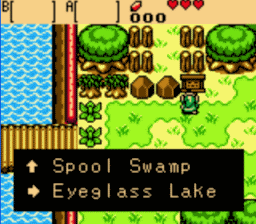
The Legend of Zelda: Link's Awakening DX
(Nintendo, 1998; Game Boy Color)

This one may not be a shock to you if you read the #18 entry in this list. Within the first month of me getting a Game Boy Color, I was treated to my first ever game in the Legend of Zelda series. Link's Awakening DX- much like Wario Land II, in fact- is a colourised version of a game for the original, greyscale Game Boy. The GBC, as it happens, was my first Nintendo console. Those first few months were crucial and turned me from a Sega fan into a lifelong Nintendo fan.

Link's Awakening DX is a fantastic entry in the Zelda series and played a big part in swinging the needle in the direction of Nintendo for me. The game plays like any of the other Zelda titles that preceded, with various weapons and items at Link's disposal. One day while exploring the seas, Link's boat is destroyed and Link awakens (clever, eh?) on Koholint Island, a mysterious uncharted island where the strange locals all refer to a bizarre deity known as the Wind Fish. Link is told that if he wants to escape Koholint Island, he must awaken the Wind Fish. To do so, he has to collect eight magical musical instruments to play the lullaby of the Wind Fish.

The island is home to all manner of Zelda bad guys from Octoroks to Tektites to a clan of Moblins. Link must traverse the dungeons of Koholint, defeat numerous bosses- including many familiar faces- and get the rare weapons and items along the way. There are all kinds of great items to pick up, including the Power Bracelet, which lets you lift heavy objects, Roc's Feather, which lets Link jumps over pits and the almighty Hookshot, which can be launched at foes across the screen and drag Link across canyons.

The boss fights are all challenging and use the items found in each dungeon in ingenious fashion. You'll be leaping over Moldorm's tail with Roc's Feather, hurling the Genie's bottle until it shatters with the Power Bracelet, charging at Slime Eyes with the Pegasus Boots and yanking out Slime Eel's innards with the Hookshot, etc, etc, etc.

The music is as good as you'd expect from a leading Nintendo title, with a host of catchy tunes that'll stick in your head. The dungeon music sets the mood for each of the levels, the overworld music is a wonderfully hummable remix of the main Zelda theme tune, the boss battle music is simple, yet manages to be an earworm that you can nod your head to while defeating the evildoers.

Perhaps most vitally in a Zelda game, the map design is clever, with each of the dungeons requiring you to use your items intelligently to survive and complete them and areas of the map requiring you to do to the same in order to advance to the next area. You'll want to explore every screen to fill in all the sections on your map screen.

The DX version of Link's Awakening not only adds colour to the game (making it vibrant and beautiful to look at) but also adds a whole new dungeon that can only be played using the GBC. The dungeon's main theme is- as you may have guessed- colour and requires you to use the game's now colour screens to solve puzzles and defeat enemies. The prize for accomplishing this is a choice of new tunics that will allow Link to either double the damage he causes or halve the damage he takes.

The Legend of Zelda: Link's Awakening DX is a masterclass of game design. If you have any interest in good video games whatsoever, you owe it to yourself to play this, one of Nintendo's finest titles.

Sunday, May 23, 2010

My Top 20 Favourite Video Games Of All Time: #16

Wario Ware, Inc.: Mega Party Game$!
(Nintendo, 2003; GameCube)

Wario has long been one of my favourite video game characters, probably second only to Sonic the Hedgehog. As I alluded to in an earlier post, Wario Land II was my first introduction to the jewel hunter. When I got my Game Boy Color, there was a fantastic game magazine called Planet Game Boy. PGB was made by the same team as the crew behind N64 Magazine. I didn't get an N64 until years later, but N64 Magazine was a must-buy magazine for me. I could quite probably wax lyrical about N64 and PGB- and maybe I will in a later blog- but for now, I'll just say that PGB gave Wario Land II five stars out of five, meaning it was worth a look in the GBC's early days.

What I got was a fantastic game that earned my loyalty as a Wario fan for all time. I don't want to spoil what's ahead on this list too much, but I will say you can expect me to go into more detail in a later entry in this series.

In 2003, Nintendo released Wario Ware, Inc.: Mega Microgame$! (one of the few times you'll see me use an American title instead of a European one, Minigame Mania is a misnomer given the games in the Wario Ware series are explicitly stated to be microgames, not minigames) on the Game Boy Advance. This is a weird one as Nintendo could probably have made a whole new franchise from the Wario Ware series but, somehow, it works as part of the Wario series.

The idea is simple: Wario is greedy and wants all the money he can get. To this end, he founds his own video games company, Wario Ware, Inc., which he plans to use to make his millions. However, Wario is also incredibly lazy and can only be bothered to make games that last about five seconds. He also enlists several of his friends to do the same and these microgames, as it happens, become a smash hit. Each of the Wario Ware games use a certain gimmick. The second one uses a gyroscope, the third one uses the DS' touch screen, the fourth uses the Wii Remote, the fifth uses the DSi's camera and the sixth lets you make your own games. The first one- well...actually, there are sort of two first ones. The version I'm inducting here is a remake of the original. But more of that momentarily.

Anyway, the gimmick in the original game is that the microgames only require you to use the A button and/or D-pad to win them. You're given a simple instruction (like "Dodge!" or "Shoot!") and have to use the five seconds to ascertain what the game objective is and then win. Each stage throws anywhere between 10 and 20 of these microgames at you, plus various speed and difficulty increases and a longer boss stage (Orbulon's microgames require extra thinking and are twice as long). Simple. And, as it happens, very addictive. Wario Ware: Mega Microgame$ won all sorts of video game design awards and its simplicity lets anyone play it. After you've beaten all the character's stages, you'll want to keep replaying to unlock all the microgames, then to get the high-scores and unlock all the bonus games.

Mega Party Game$ is much the same story. As I said above, it's a remake of the original GBA game and, thus, features all the original microgames. This time, however, there are all kinds of awesome multiplayer games to play. There are loads of play modes to unlock, be it simple winner-stays-on games, space shooting games or games where the losers must balance on increasingly unstable piles of turtles (yes, turtles- the Wario Ware games are well known for their madcap insanity) until eventually only one player is still standing.

The Wario Ware series is a laugh riot on your own, with homages to Nintendo games, nonsense games and a host of recurring gags (there is always a game that revolves around nose picking) that will have you laughing long and hard. With a group of friends, though, there is no more enjoyable game to play. This is one party you simply must attend.

Saturday, May 22, 2010

My Top 20 Favourite Video Games Of All Time: #17

Streets of Rage
(Sega, 1991; Mega Drive, Game Gear, Master System, Mega CD, Arcade, Virtual Console, iPhone OS, various compilations)

I was once again quite tempted to induct an entire series here, but the important thing is that this list is about my favourite games, not necessarily the ones that are the best. As it pertains to Streets of Rage, the second entry in the series is probably the best of the three, but number one holds the most happy memories for me.

Double Dragon is pretty much to blame, so to speak, for SoR's existence. In 1987, the popular game essentially kickstarted the gaming populace's enthusiasm for side-scrolling beat-'em-ups. Two years later, Capcom would release the astoundingly good Final Fight, which has any number of classic moments and characters in it, with some crossing over into other games as Final Fight conveniently takes place in the same fictional world as Street Fighter. Also in 1989, Sega would release the first game in the Golden Axe series. Now, I like Golden Axe, it's a fun game with some neat characters, memorable music and some cool magic attacks. However, the game moves at a crawl and gets blindingly repetitive incredibly quickly. However, Golden Axe was a basic groundwork for Sega to work off of. The franchise's sequels were vast improvements over the original. More importantly, it was essentially something of a framework SoR could use.

Streets of Rage exploded onto the Mega Drive in 1991. The story focuses on three renegade ex-cops, who quit the force when they became disgusted at the level of corruption in the police force. With city officials powerless, the city falls into the hands of crime lord Mr. X. Those three former cops, Adam Hunter, Axel Stone and Blaze Fielding, must take back the streets the only way the punks will understand- by stoving their faces in!

The game's pretty simplistic, with most levels following a linear left-to-right desgn, though the nifty elevator level helps change things up (and lets you hurl foes hundreds of storeys to the pavement!). The three ex-cops each have their own strengths and weaknesses, not to mention their own special moves. They also get to call on one of the few honest cops on the force who can launch a huge missile strike and knock out all enemies on screen.

It's really in the character design that the game shines. As well as the three player characters- each of whom are well known to Sega fans from the 1990s- the enemy roster is pretty impressive. True, after a few levels you're in palette swap territory, but the individual enemies are all really well designed and their personalities shine through. It's obvious that Galsia is a useless feeb, Signal's a little bit more of a bad ass and Abadede is the Ultimate Warrior from 1990s wrestling. Well, okay, maybe not, but he's clearly based on him.

When you finally reach Mr. X, the game does something interesting. You're offered the chance to join Mr. X's crime syndicate. Any true gamer knows the only correct response is Axel's Bare Knuckle Punch to the crotch, but if you accept his offer one of two things will happen. In a single player game, you'll be forced to replay the last level (a boss rush level) and then eventually get the bad ending. In a two player game, you'll fight one another for control of the syndicate. It's a pretty neat nod to Double Dragon where two players would end up fighting to see who got the girl.

One of the best things about SoR is its awesome soundtrack by Yūzō Koshiro. The tunes in the game are all catchy and quite memorable, the theme for level one and the boss theme being two of the best. In a way it's unusual that Sega of America would decide Sonic CD's soundtrack needed altering for a North American market since the fans wouldn't accept the style of music in the Japanese soundtrack when, all considered, Koshiro's SoR soundtrack played to the same kind of music. But that debate's a story for another time.

SoR was greatly improved upon in its sequel and the third entry in the series is pretty strong too (it's largely personal opinion as to which one is better). The sequels added more characters and enemies and ramped up the difficulty factor. There were also comic strips in the pages of Sonic The Comic (which served as my first introduction to the series). All in all, if you fancy a bit of a retro treat, there aren't many classic games on the Mega Drive that can outdo the original Streets of Rage.

Friday, May 21, 2010

My Top 20 Favourite Video Games Of All Time: #18


The Legend of Zelda: Oracle of Seasons and Oracle of Ages
(Capcom & Nintendo, 2001; Game Boy Color)

Again, I'm slightly cheating with this one. As before, however, both games probably do deserve to be listed together as they form one larger adventure. Allow me to elaborate.

In 1998, Nintendo released the Game Boy Color. The hardware was basically the same as it was on the original Game Boy and Game Boy Pocket, but this time- as the name suggests- it could display in colour. This was the only thing that had truly been missing from the original Game Boy models, though since competitor handhelds that had colour screens had miniscule battery life, it seems Nintendo were wise enough to wait until technology allowed them to make a handheld that wouldn't require a fresh set of batteries every six hours.

When I first got my GBC, the shop only had the original, non-colour games in stock. Obviously this kind of ridiculous oversight simply wouldn't be allowed these days but I ended up buying Super Mario Land 2: Six Golden Coins, which is one of the most enjoyable platformers on the Game Boy, and Donkey Kong Land III, which is also pretty great. Shortly after that, my dad went away on a business trip to America and brought me some GBC games back including Wario Land II and The Legend of Zelda: Link's Awakening DX. Awakening was the first Zelda game I'd ever played and it was absolutely astounding. I played the game through to the end and then replayed it until I'd done all I could. When I heard there were to be three more Zelda games on the GBC, I could barely wait for them.

Now, you may be thinking, "Three? But there are only two games in this article". As it happens, the original plan was to have three games in the Oracle series (or Mystical Seed as it was known at the time) and each would be named after the three Triforce: Power, Courage and Wisdom. Each of the games could be played in any order but they'd be able to link up with either or both of the other two. Capcom, who made the games, hit a snag in programming and it became unfeasible that they'd be able to get all three games out without delaying the game massively. Since the Oracle games were to be Nintendo's big finale for the GBC before the Game Boy Advance arrived to replace it, that simply wasn't an option; thus, one of the games was dropped. The two that survived retain the link-up feature, which is really what makes them so special.

As mentioned above, the games can be played in any order and both of them have a special gimmick. In Oracle of Seasons, you'll visit Holodrum where you'll be able to wave the magical Rod of Seasons and change the season. The landscape alters around you as it does in the real world, with different paths opening based on the season. You'll also get to visit the bizarre subterranean world of Subrosia, where the lovable Subrosians live- you even get the dubious honour of performing That Popular Subrosian Dance!

In Oracle of Ages, Link heads to Labrynna and gets to wield the Harp of Ages, allowing him to travel between the past and present. The landscape is greatly different in the past, as one may expect, which changes the layout of several areas.

In both versions, you'll befriend one of three animals. You'll meet them all, but one of them will be yours to call upon whenever you like. There's Dimitri the Dodongo, who'll wade through water and eat obstacles, Ricky the Kangaroo with his huge boxing punches and Moosh the Bear who can fly over gaps. These three pets are great and you'll find yourself calling on your animal buddy time and again, even when you really don't need to, purely because it's fun.

So, then, on to the matter of how the games link up. Completing one of the games gives you a password. Entering this password on the second game will let you transfer over all the magical rings you found in the first game (the only way to get a full collection) and, more importantly, it will unlock a whole host of areas otherwise inaccessible, including a Donkey Kong-style level where you have to leap over obstacles to save Zelda! This is also the only way to face the final boss of the two games. There are also tons of little details that affect gameplay if you link up. All things said, to see everything in this game, you'll have to play through a minimum of twice each.

Everything about these games is wonderful from the level design to the graphics to the music to the fantastic story. If you're playing on a Game Boy Advance, there's an extra bonus for you as two inaccessible areas open up (one per game, that is). With these games, Capcom proved they could be trusted with Nintendo's characters and that allowed something special to happen further down the line. But more on that in a later entry in this list...

Thursday, May 20, 2010

My Top 20 Favourite Video Games Of All Time: #19

Street Fighter IV series
(Capcom, 2008-2010; Arcade, Xbox 360, PlayStation 3, PC)

This is a bit of a cheat, I know. I'm inducting a series as one entry. In this case, though, I'm sure you'll be able to forgive me. Street Fighter sequels are often updates of earlier installments and that's the case with Super Street Fighter IV being, as it is, the updated version of Street Fighter IV. Super is also the most recent game in this list.

In 1987, the original Street Fighter hit arcades and was later ported to home consoles. It's also available on Capcom Classics Collection - Volume 2. It's really nothing special; aside from some Engrish voice acting that's been grinded through a digitiser, there's not a lot you'll hold in your hearts when it comes to this game. To be totally honest, by today's standards (and certainly compared to its successors) it's all-but unplayable. The CPU is overpowered, the player's moves are extraordinarily difficult to pull off with any real level of success, it's slow and clunky and generally just not all that fun.

1991's Street Fighter II, though, was a different story. Whereas the original had only let you play as Ryu or Ken (the latter only if you were player two), there were eight characters to select in SFII, each with their own special combos and attacks. The game set the industry on fire and revolutionised fighting games. It spurred developers to create a "Street Fighter-beater". Some, like Midway's Mortal Kombat, met with success, though dozens more remain forgotten to the ages.

Street Fighter II received various updates and revisions to fix bugs, add moves and animations and, most vitally, add stages and characters not present in the original. By the final major revision in 1994, there were 17 characters to choose from, each of whom are known and beloved by practically all video game enthusiasts today. Capcom, however, knew they couldn't rest on their laurels. It was all well and good creating revisions of SFII, but the industry was moving on. While SFII had met with the greatest fortune on the SNES, the rest of the gaming world was now focusing on what the PlayStation could do and Capcom needed to think of a winning title.

What they came up in 1995 with was the midquel series Street Fighter Alpha. Set between Street Fighter and the canonical version of SF2, Super Street Fighter II Turbo, the Alpha series filled in many of the characters backstories, gave them motivations and rounded out the world a little more. There were dozens of new faces as well as old favourites from the previous two series. Street Fighter Alpha proved to be a roaring success, but Capcom knew the fans wanted the SF series to progress forwards. In 1997, they unleashed the first game in the Street Fighter III series upon the world.

To say fan reaction to SFIII was lukewarm is putting it appropriately mildly. Fans loved the fluid animation and new challenges the games provided, but they missed their favourite characters. Aside from Ryu, Ken, Chun-Li and Akuma, SFIII had featured an all-new cast- and of those four only Ryu and Ken were in the first game of the series. There were some new characters the fans liked but, for the most part, nobody really grabbed anyone's attention. On top of that, there were some truly hideously bad character designs in the series, many of whom with astoundingly bland and clichéd backstories. In 1999, Street Fighter III: 3rd Strike was released and it was the final game of the SFIII series. It was really around this time that arcades started losing popularity outside of Japan. It wasn't SFIII's fault, but the series wasn't helped by it.

So that was it for Street Fighter, or so it seemed. Capcom spent the largest part of the next decade re-releasing the SFII and Alpha games- the most successful ones- and just generally letting the series get by on former glories. Capcom were incredibly resistant to the idea of releasing a new Street Fighter sequel, perhaps worried the response would be as uninspiring as it was with SFIII. However, fan demand and the popularity of Super Street Fighter II Hyper Fighting on Xbox Live essentially forced Capcom's hand and the high-definition Super Street Fighter II Turbo HD Remix (which is, in its own right, an astounding game and one of the best versions of SFII there is) only confirmed Street Fighter IV was the right move.

When the game was released, fans breathed a sigh of relief to see almost all of their old SFII favourites back. The only two missing faces from that game were Dee Jay and T. Hawk. In addition, the new characters this time around- including luchador El Fuerte and obnoxious, obese jerk Rufus- are all fantastic. The moves have never looked better, especially the killer Ultra moves to really finish off whichever poor sap gets in your way. The story is also excellent, concerning the rise of S.I.N., Shadaloo's weapons development divsion, and its leader Seth, who wants all of Bison's power for himself.

The music is, unfortunately, not as memorable as it was in SFII, but then that was never going to be easy. There are still some awesome tunes like Seth's theme and the stage theme for the stage where you fight near an erupting volcano (!), however. The online mode is a quite refined version of SSFIITHDR's online gameplay, too, which only adds to the package. On top of all that, you can finally play as Ryu and Ken's master, Gouken. The insanely strong warrior is a formidable fighter against any comers!

Special editions of the game also came with an animated movie, Street Fighter IV: The Ties That Bind that fills in a lot of the gaps in the somewhat spotty plot. It's one of the best SF movies made, too, with strong voice acting and a fantastic story.

Two years later, the first revision, Super Street Fighter IV, was released. All the challenges from the first version were retained, but this time the bonus stages from Street Fighter II made their return. They weren't all that returned, however, as the last two SFII characters came back, and they were joined by a group of SFA and SFIII characters, plus Guy and Cody from Final Fight! On top of that, there are two newcomers in the form of evil Korean Juri and the Turkish oil wrestler Hakan, as well as some gorgeous new stages to fight on.

Whether any further revisions of Street Fighter IV will come out remains to be seen, but if they're as good as the preceding games, they'll be incredible too.

Wednesday, May 19, 2010

My Top 20 Favourite Video Games Of All Time: #20

Dragon Ball Z: Budokai Tenkaichi 3
(Bandai, 2007-2008; PlayStation 2, Wii)

I know, I know, there's a bit of a stigma attached to Dragon Ball, the notion it's something of a franchise for anime nerds and people stuck in the 90s, but I can't get enough Dragon Ball and this game is my favourite in the series.


As fighting games go, DBZBT3 is pretty simplistic. It's not trying to beat King of Fighters for depth, but it's certainly an awful lot more accesible to casual players and that works very well in the game's favour. You can learn characters right down to their individual combos and special moves, or you can simply hammer the basic attack button, stopping only to fire the ocassional ki blast. It matters little what your play style is or how much time you can invest in the game.

Speaking of the special moves, the number of invidivualised special moves is astonishing. Each character has multiple signature and Ultimate Blast "finishing" moves. Given there are 161 characters in the game (!) that's really impressive! Yes, you read that right, 161 characters, including transformations, each with their own special abilities, powers and weaknesses. The game closely follows the anime version of the Dragon Ball epic adventure, with characters and locations from the original Dragon Ball, Dragon Ball Z and Dragon Ball GT, plus the many Dragon Ball movies. Mastering all of them will take some serious time!

Perhaps most enjoyable is the Dragon History play mode. This lets you relive iconic fights from the series' history. You start off in the Saiyan Saga, progress to the Android and Cell Sagas, and finish up in the Majin Buu Saga, with plenty of other little sagas in between. After that, you can play through GT and the original Dragon Ball sagas. There are also loads of fights from the movies to relive as well as some "what if...?" scenarios and it'll take you days to see them all. On top of all that, the Funimation team return to reprise their roles from the anime and, yes, the line "It's over 9000!" does make an appearance. Dragon Ball fans will be in their element.

Once you've completed Dragon History, you may as well check out the game's other challenging modes, which offer literally hundreds more fights, with dozens of combinations of characters for you to battle and a multitude of items to unlock and use to customise your character's fighting skills with. If you want to max out the stats of all 161 characters, suffice to say you'll be playing for years!

Of course, no Dragon Ball game would be complete without the titular balls themselves! Collecting all seven of them by finding them in destroyed landscapes and then winning the fight allows you to summon the great dragon Shenron, who will grant any wish you may desire (as long as you wish for a special item, a new fight stage, a bunch of money or super-secret characters!).

The Wi version of DBZBT3 is even better. Rather than just tell your characters to deliver their special attacks by pressing a command, you have to make the motion yourself, which really brings you into the game. The Kamehameha, for instance, the most famous move in the series and Goku's signature attack, is done by drawing the Wii Remote back to your side as if you're collecting energy, then thrusting it forward like you're throwing a huge burst at your opponent! The thrill of delivering one of these special moves in the nick of time is really unmatched by any other game.

Ultimately, it's not truly possible to fully recommend DBZBT3 to people who aren't already Dragon Ball fans. But if you feel like giving an exhilarating game a chance, where you fly around the screen firing off energy bursts, with dozens of characters to play as and hundreds of fights to play through, this could be the game for you.